
Mold Making for Injection Molds – Complete Value Creation from a Single Source
A high-quality injection mold is far more than “just” a steel mold: it is the heart of a stable, cost-efficient serial production process. In our in-house mold shop, the foundation is laid for whether your component can later be produced dimensionally accurate, visually flawless, process-reliable, and economically efficient – over thousands to millions of cycles.
At Peiler & Klein Kunststofftechnik GmbH, mold making stands for a fully integrated process chain: from the initial idea through mold concept development, mold design (CAD), manufacturing (e.g. CNC milling, wire cutting, EDM), assembly, tryout, sampling/first article approval, and serial production support. This delivers speed, quality, and protects sensitive know-how – especially when geometries are complex or components must meet demanding standards in automotive, electrical, medical, or consumer goods/cosmetics industries.
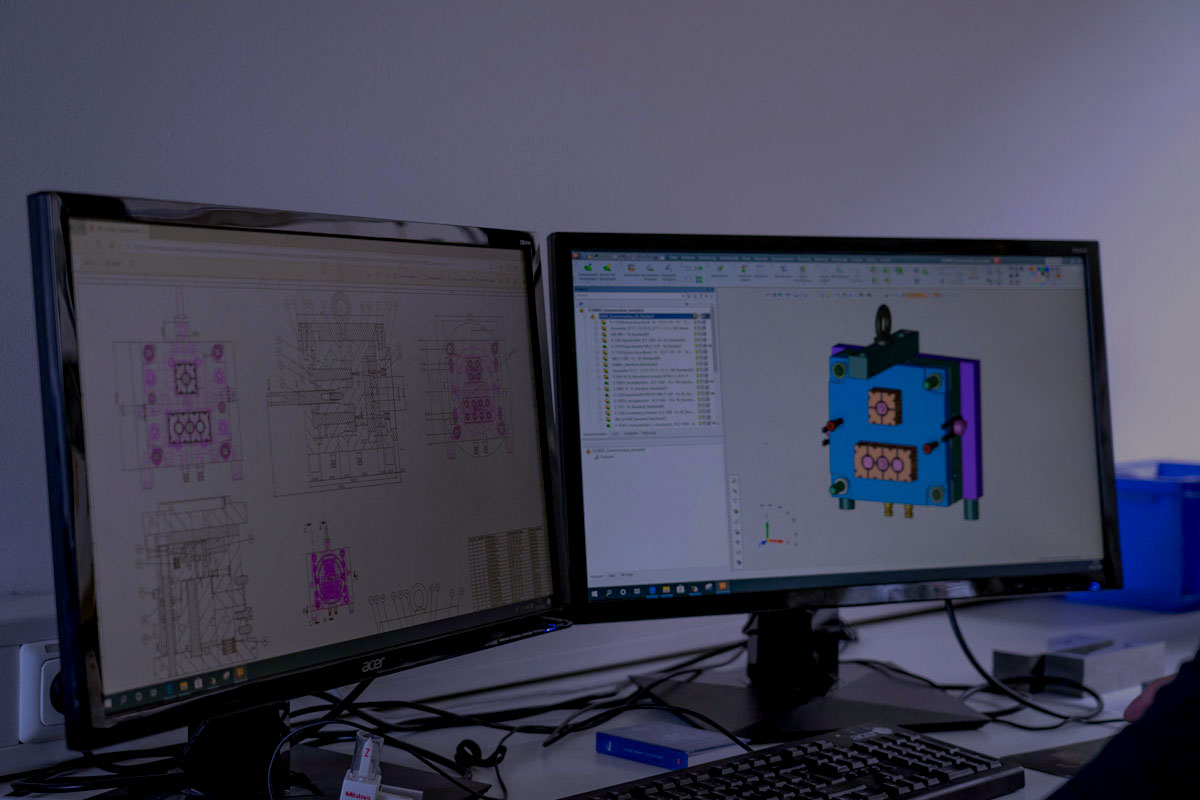
Value Creation in Mold Making: Process Flow in 10 Clear Steps
1. Inquiry, Data Check & Feasibility Analysis (DFM)
Everything starts with a solid foundation: 3D data (STEP), drawings, tolerances, material requirements, and production volumes. During the feasibility analysis / DFM (Design for Manufacturability), we evaluate topics such as:
- Demoldability (parting line, draft angles, undercuts)
- Functionality & assembly points (snap fits, sealing areas, clips)
- Surface requirements (visible parts, high gloss, texture)
- Risks such as warpage, sink marks
- Target values: cycle time, scrap rate, mold lifetime
Result: a clearly defined specification sheet – practical, reliable, and ready for concept development and costing.
2. Mold Concept: The “Architecture” of Your Injection Mold
In the mold concept phase, we define the fundamentals that later determine cost and quality:
- Number of cavities (single-cavity, multi-cavity, family mold)
- Moldflow analysis
- Runner system: cold runner or hot runner (material savings, CO₂ footprint, part appearance)
- Venting and ejection concept
- Coatings
- Movements: slides, core pulls, index plates (depending on part design)
- Temperature control/cooling: channel layout, cooling circuits, conformal cooling where required for cycle time and quality optimization
Goal: a robust, maintenance-friendly mold that performs reliably in serial production – not only during the first trial run.
3. Mold Design (CAD): From Concept to Production-Ready Tooling
During mold design, the complete 3D mold model is created – including standard components, inserts, and functional assemblies.
Typical contents:
- Mold base layout (fixed side / moving side), guiding, centering
- Inserts, cores, contours, parting lines
- Ejection systems, slide mechanics, core pulls, safety features
- Cooling/temperature control plan, connections, seals
- Electrode design (for sinker EDM), CAM preparation
This transforms a component idea into a precisely manageable manufacturing project.
4. Simulation & Optimization (Optional, but Often Highly Valuable)
Depending on component requirements, simulations such as Moldflow support decisions regarding gate position, wall thickness distribution, or temperature control – helping reduce common issues such as warpage or surface defects at an early stage.
Especially for thin-wall parts, visible components, and tight tolerances, this creates clear advantages.
5. Manufacturing: CNC Milling & High-Precision Machining
Now the process becomes metal-focused: mold components are manufactured from suitable tool steels.
Depending on the application, corrosion-resistant and hardened steels may be used (e.g. for optical visible surfaces, medical applications, or abrasive compounds).
Core processes in mold manufacturing:
- CNC milling (3-axis / 5-axis, roughing / finishing)
- Drilling, countersinking, threading
- Grinding for fits and sealing surfaces
Many mold makers describe this production chain (CNC + EDM) as the central basis for precision and repeatability.
6. EDM: Wire EDM & Sinker EDM for Sharp Contours
Where milling reaches its limits (deep ribs, fine edges, tight radii, textured areas), EDM comes into play:
- Wire EDM (precise contours, separation cuts)
- Sinker EDM (detailed geometries, hard-to-machine areas)
This combination of CNC and EDM is standard in injection mold manufacturing for complex geometries.
7. Heat Treatment & Surface Finishing: Lifetime, Appearance, Process Stability
Depending on tool steel and application, processes may include hardening, tempering, nitriding, or coating.
For visible parts, surface finishing is especially critical:
- Polishing (up to mirror finish)
- Texturing / grain structures (according to specification)
- Laser texturing (for defined grip or design features)
Goal: desired part appearance combined with a durable mold surface.
8. Mold Assembly & Functional Testing
During assembly, all components are integrated: inserts, slides, ejectors, cooling systems, hot runner (if required).
Then follows functional testing:
- Smooth movement of slides/core pulls
- Leak-tight cooling circuits
- Fits, parting lines, ejector operation
- Safety and maintenance accessibility
9. Tryout & Sampling (T0 / T1 / T2) – From First Shot to Approval
During tryout, the mold is tested for the first time under real injection molding conditions.
Typical stages:
- T0: first internal trial, check basic functionality, identify initial issues
- T1 / T2: optimized runs with corrections, stabilize process window, finalize function and appearance
Sampling / first article approval demonstrates that part and process meet all requirements – often including dimensional reports, PPAP/EMPB documentation, and formal approval.
10. Serial Production Support: Maintenance, Modifications, Repairs, Spare Parts
An injection mold is a long-term production asset – and requires care.
Therefore, mold making does not end with delivery:
- Regular maintenance & servicing
- Repairs and rapid support in case of unexpected failures
- Modifications / optimizations (e.g. venting, gate location, ejectors, cycle time)
- Spare parts, documentation, mold history tracking
Many specialized mold makers emphasize this after-sales service as a decisive factor for delivery reliability and minimal downtime.
What a Good Injection Mold Must Deliver Today
A modern mold concept optimizes not only “mold = part”, but above all serial production efficiency:
- Short cycle times through intelligent cooling / temperature control
- Consistent part quality (dimensional accuracy, low warpage, excellent surfaces)
- Maintenance-friendly design (fast replacement of wear parts)
- Long service life and process reliability – even in 24/7 production
- Scalability: from prototype to pilot series to high-volume production
Especially temperature control is often the biggest lever: homogeneous mold temperature reduces warpage, scrap, and cycle time; conformal cooling can provide significant advantages depending on the application.